 Download App
Ad-din Akij Medical College (AAMC), Khulna


_1790252120.png)

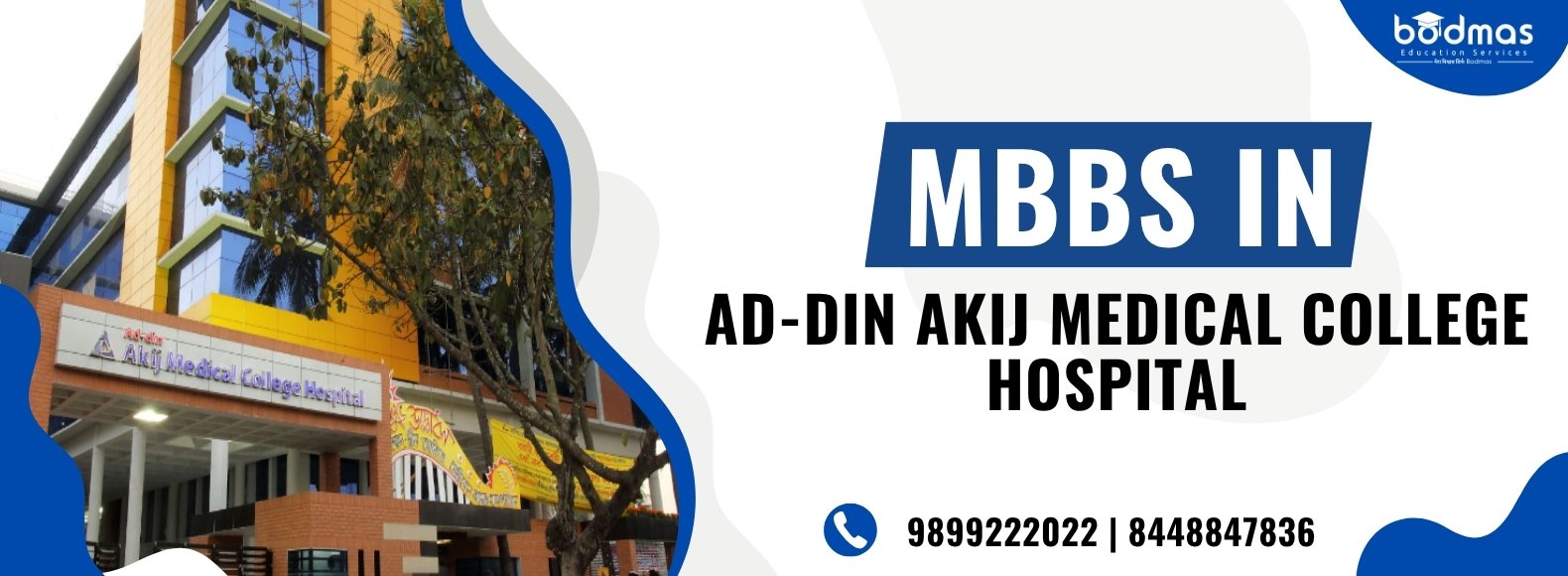
Ad-din Akij Medical College (AAMC) has gradually built its institutional legacy since its establishment in 2013, combining contemporary medical education with a serious commitment to regional healthcare development. The institution is part of the broader Ad-din Foundation, a healthcare-driven philanthropic organization in Bangladesh that has contributed meaningfully to hospital services, medical education, and community health initiatives over the past years. This connection underlines AAMC's foundational philosophy of blending academic rigor with societal impact.
Founded to address both healthcare and educational needs in Khulna and its surrounding districts, AAMC has developed alongside AAMCH (Ad-din Akij Medical College Hospital), which serves as the primary teaching hospital. Over the years, the institution has invested considerably in building contemporary classroom facilities, laboratories, and specialized clinical departments, offering quite a robust platform for both UG education and practical training. Its affiliation with the regional medical university (Khulna Medical University) and recognition by BMDC (Bangladesh Medical and Dental Council) mirrors its adherence to national medical standards and regulatory compliance.
AAMC meets the primary baseline that any potential Indian candidate must verify:
These formal recognitions are vital because they determine whether the curriculum adheres to national standards, whether a degree issued on course completion will be valid, and whether graduates are eligible for international licensing processes, including the Indian licensure pathway.
From an Indian student's perspective, recognition by BMDC is essential but not enough. Indian regulatory acceptance requires that the foreign college be listed in international directories and meet external criteria established by Indian licensing regulators; thus, a student must make sure that the college name appears in current lists used by NMC (National Medical Commission) for permitting foreign medical graduates to appear for the licensing examination (FMGE/NExT) and for subsequent registration.
For the 2026–2027 academic session, Ad-din Akij Medical College (AAMC), Khulna has published a total course fee of USD 33,500 for the five-year MBBS programme for foreign students. The stated course fee includes admission, tuition, session and hostel fees.
Note: The USD 33,500 amount is the published five-year course fee and includes admission, tuition, session and hostel fees. Food, utility charges, hostel security, registration fees and the internship fee are payable separately as specified in the college's fee document.
Quality of education in a medical institution is multidimensional: curriculum alignment with professional standards, teaching and learning resources, faculty qualifications and stability, assessment rigour, and student academic support.
Clinical training is regarded as the cornerstone of medical education; the attached teaching hospital's size, patient throughput, and case mix determine how much practical competence a student can acquire.
AAMC is attached to Ad-din Akij Medical College Hospital, which is a multi-specialty teaching hospital with significant bed strength. The hospital boasts of emergency services, ICUs, CCU, NICU and other specialized units, which permit exposure across a wide range of medical and surgical procedures. For Indian students, adequate and supervised clinical exposure in core disciplines (medicine, surgery, pediatrics, obstetrics & gynaecology, community medicine etc.) is non-negotiable, and hospital capacity is a first-order pointer of the likely caseload and learning breadth.
Support infrastructure—contemporary diagnostic services (laboratory, imaging including CT and ultrasound), pharmacy, blood bank, and critical care capabilities—directly affect the quality of clinical learning. AAMC hospital has ICU, HDU and blood bank facilities.
Safe, sterile, and study-conducive accommodation is a substantial factor in international student welfare.
AAMC has two on-campus hostels—separately allocated female and male hostels—with defined seat capacities. The presence of campus hostels lessens daily commute time, far increases access to campus resources, and offers a controlled environment which is very often preferred by guardians of international students including Indian students.
Security arrangements, presence of hostel superintendents, and a formal rule structure; these governance elements are important when assessing whether living conditions will be unswervingly managed. AAMC scores in this regard.
Quality markers for hostel life include availability of mess and the menu's capacity to accommodate dietary preferences (vegetarian choices and Indian-style meals), room occupancy norms (single/double/shared), internet reliability, water and power backup, medical support, laundry facilities, and rules governing visitors and curfew. AAMC hostel scores well in this regard.

Here are the documents needed for admission (especially for international/Indian students):
Here is the step-by-step process for foreign applicants:
Khulna, the city where Ad-din Akij Medical College (AAMC) is located, is very well-connected to India, offering multiple travel choices by road, rail, and air. Its closeness to eastern Indian states, especially West Bengal, Assam, and Tripura, makes it easily accessible to students from both nearby and distant regions.
Khulna is accessible via multiple border crossings from India, with Petrapole–Benapole definitely being the most frequently used. From Kolkata, the distance to Khulna is around 146 km, easily covered in 4–6 hours by private car, taxi, or intercity bus. Buses operate on daily basis from Kolkata to Khulna, offering both daytime and overnight services. Students from northern or northeastern India can also travel via alternate border points, such as Changrabandha (West Bengal), Hili (West Bengal/Bihar), or Akhaura (Tripura). For example, from Siliguri or North Bengal, students can take buses or private vehicles to Hili, cross into Bangladesh, and continue by road to Khulna (total distance ~400 km, 10–14 hours). Similarly, students from Tripura or Assam can cross at Akhaura and travel via Comilla to Khulna.
Khulna is accessible from India via direct international train services. The Bandhan Express connects Kolkata (Chitpur Station) to Khulna Railway Station (KLNB), covering 172 km in about 5 hours and 20 minutes. This is a bi-weekly service offering AC First Class (1A) and AC Chair Car (CC) seating. Immigration and customs checks are carried out at Kolkata and Khulna stations. Students from other parts of India can combine domestic air, train or bus travel to Kolkata before boarding. Furthermore, students can use other international trains to Dhaka, such as the Maitree Express (Kolkata–Dhaka) or the Mitali Express (New Jalpaiguri–Dhaka), then proceed to Khulna by bus or train. These choices expand access for students from Bihar, Jharkhand, Odisha, and northeastern states.
For students traveling from western, southern, or northern India, air travel is the most practical option. The nearest international airport is Shahjalal International Airport, Dhaka, about 230 km from Khulna. Airlines including Biman Bangladesh Airlines and regional carriers operate flights from cities such as Bangalore, Chennai, Delhi, Kolkata, and Mumbai. From Dhaka, Khulna is easily accessible via intercity trains or buses, taking 3–4 hours. Air travel is especially useful for emergencies, vacations, or long-distance travel.
Get expert guidance for admission, documentation, and complete support from Bodmas Education Services.
Connect with our Bangladesh MBBS admission experts
Complete support from college selection to final admission
Contact us today — our expert counsellors are ready to guide you at every step.
Fill in your details and we'll reach out shortly.
Powered by Froala Editor